MAY 2026 HEALTH LAW UPDATE
Dear Health Law Section Members:
The Health Law Section (“HLS”) website has been updated with the following articles on significant developments in health law that may interest you in your practice.
By: Rosanna M. Catalano, Esq., Arrow Group (a subsidiary of Gunster)
By: Marcy Hahn-Saperstein, Esq., and John C. Hood, Esq., Akerman LLP
By: Grant P. Dearborn, Esq., Shumaker, Loop & Kendrick, LLP
By: Hannah Lief, Esq., Shraiberg Page, P.A.
By: Grant P. Dearborn, Esq., Shumaker, Loop & Kendrick, LLP and Jeanne E. Helton, Esq., Smith, Hulsey & Busey
- FEDERAL LAWS AND REGULATIONS. 15
- Part 2 Civil Enforcement Is Here: Practical Takeaways for Florida Providers, Payers, and Health Systems. 15
By: Ana Liz Quesada-Gordillo, J.D.
By: Natalie Shoemaker, Esq., Swope, Rodante P.A.
By: Roger B. Handberg, Esq. and Julie Posteraro, Esq., GrayRobinson, P.A.
These articles are presented to HLS members for general information only and are not legal advice from The Florida Bar or its Health Law Section. HLS thanks the volunteers who have generously donated their time to prepare these articles for our members.
Best,
John C. Hood, Esq., Akerman LLP, HLS Update Editor-in-Chief
Trish Huie, Esq., Patricia A. Huie, PLLC, HLS Update Editor
I. STATE LAWS AND REGULATIONS
Legislative Health Care Update
When Florida lawmakers gaveled out of their 2026 session in early March 2026, they made changes to the state’s healthcare system including restricting what pharmacy benefit managers (PBMs) can require of pharmacies and creating pathways for the licensure of naturopaths and specialty license of memory care services offered at Assisted Living Facilities. A total of 237 bills were enrolled this session, down from 269 in 2025 and 325 in 2024.
Although the Florida legislative session ended several weeks ago, lawmakers still did not pass a budget, so they are expected to return to Tallahassee in the coming weeks to pass a budget. As of the end of the regular session, House and Senate spending plans remained approximately $1.4 billion apart. The new fiscal year begins July 1.
CS/HB 697, Drug Prices and Coverage
CS/HB 697 reigns in PBMs by prohibiting PBMs from forcing pharmacies from dispensing a prescription drug or biological product for a loss and from playing favorites and giving parent healthcare conglomerates more market power by reimbursing an affiliated pharmacy more than a nonaffiliated pharmacy. The bill carves out in-network pharmacies by allowing them to submit consolidated appeals under certain circumstances to PBMs. Meanwhile, the bill makes temporary changes to eligibility and benefits for the Ryan White Part B AIDS Drug Assistance Program, applicable through June 30, 2026, to cover a deficit and to override certain changes in Department of Health (DOH) policy.
The bill was signed by the Governor on March 24, 2026, and takes effect July 1, 2026.
CS/SB 688, Naturopathic Medicine
For nearly 70 years, Florida has not licensed any new naturopathic doctors, but that changes with CS/SB 688. The bill reestablishes the licensure and regulation of naturopathic doctors by creating a Board of Naturopathic Medicine within DOH. Additionally, the bill defines the scope of naturopathic practice to include specified diagnostic and natural treatment modalities including, by not limited to, homeopathic remedies, laboratory testing, lifestyle medicine, dietary supplements, and botanical or fungal extracts. However, the bill expressly withholds prescriptive authority for legend drugs or prescription drugs, except as expressly provided for certain natural, nonpharmacologic substances. The bill does bring the practice into the modern era by allowing naturopathic doctors to provide services through telehealth.
If approved by the Governor, the bill takes effect December 31, 2026.
CS/CS/SB 1404, Memory Care
CS/CS/SB 1404 requires assisted living facilities to obtain a specialty license for “memory care services” before providing such services to memory care residents or advertising as a memory care provider.
The bill directs the Agency for Health Care Administration (AHCA) to adopt rules by June 1, 2027, establishing minimum standards for these services and defines the terms “memory care resident” and “memory care services.” The bill also establishes the Florida Alzheimer’s Center of Excellence within the Department of Elderly Affairs to assist and support people with Alzheimer’s disease and related forms of dementia, as well as their caregivers.
If approved by the Governor, the bill becomes effective upon the date when the AHCA’s rules implementing memory care services licenses take effect.
Other Health Care Bills
Other health care bills that passed both chambers and are making their way to the Governor are:
- SB 340, Human Trafficking Education for Nurse Licensure: Requires registered nurses and licensed practical nurses to complete a course on human trafficking for initial licensure.
- SB 1030, Recovery Residences: Changes background screening level for certain individuals; no longer requires certain existing licensed service providers to admit individuals during the probationary licensing period under certain conditions.
- SB 1092, Podiatric Medicine: Revises continuing education requirements for certain podiatric physicians and authorizes the use of cellular or tissue-based products not approved by the FDA under certain circumstances.
- HB 569, Forensic Client Services: Revises the definition of “forensic client” to include people committed to involuntary residential services in a secure facility of the Agency for Persons with Disabilities.
- SB 1246, Linking Industry to Nursing Education (LINE) Fund: Expands the fund to cover shortages in health science professions beyond nursing.
- HB 1121, Aging and Disability Services: Revises aging and disability services provided by the Department of Elder Affairs.
- HB 809, Temporary Certificates for Practice in Areas of Critical Need: Creates a pathway to permanent licensure for physicians already practicing in areas of critical need under temporary certificates.
- HB 1347, Clinical Laboratory Personnel: Changes current state requirements for performing moderate or high complexity laboratory testing by adopting federal clinical laboratory personnel qualifications as the minimum licensure requirements for clinical laboratory technologists and technicians.
- HB 867, Dry Needling by Occupational Therapists: Allows occupational therapists to perform dry needling, and establishes minimum experience, education, and training requirements to do so.
Outside of these healthcare bills, the most closely followed bills this session centered on property tax relief including several proposals to eliminate or reduce non-school property taxes for homesteads, artificial intelligence regulation (SB 482, HB 1395, HB 659), claims against the government (HB 145, SB 1366), rural communities (SB 250), and the Department of Agriculture and Consumer Services (SB 290, HB 433).
Submitted and authored by Rosanna M. Catalano, Esq., Arrow Group (a subsidiary of Gunster).
DON’T FORGET YOUR LICENSE: Florida’s New Memory Care Services Specialty License for ALFs
The Florida Legislature has identified a regulatory gap. As Florida’s population experiences a “silver tsunami,” the number of people who currently live with Alzheimer’s disease or related dementias (collectively, Dementia) is expected to increase sharply. Lawmakers concluded that existing Assisted Living Facility (ALF) regulations are insufficient for this growing and vulnerable population that requires specialized care.
To address this concern, the Florida Legislature recently passed, without opposition, a bill (Bill, CS/CS/SB 1404) that will create a new specialty license for ALFs. Pending the governor’s expected signature, the Bill will require that certain ALFs obtain a memory care services license to provide memory care services, serve memory care residents, or advertise themselves as offering those services or serving such residents.
Background
Currently, ALFs in Florida may provide routine personal care services under a standard ALF license. While they are required to hold a specialty license to provide (i) extended congregate care, (ii) limited nursing services, or (iii) limited mental health services, no such specialty license is required to provide “memory care.”
In the absence of consistent standards under existing law, ALFs may advertise that they provide memory care without demonstrating that they comply with any specific greater standards for such care, staffing, training, or safety. Instead, ALFs that advertise offering memory care are subject to flexible standards that require (i) disclosing certain information about the memory care services they offer, (ii) having an awake staff member on duty 24/7 (only if the facility has 17 or more residents), (iii) offering activities designed for cognitively impaired individuals, (iv) providing a safe physical environment, and (v) employing staff who meet certain training and continuing education requirements.
But the Legislature noted that these minimum requirements lack specificity and that families making placement decisions for loved ones with Dementia cannot easily compare different facilities’ programs. Accordingly, the goals of the Bill are to (i) enable the Florida Agency for Health Care Administration (AHCA) to ensure that facilities provide the services they advertise, (ii) develop distinct operational requirements for ALFs offering memory care, and (iii) provide consumers greater clarity into the type and quality of memory care that ALFs offer so family members can make informed placement decisions.
This Bill now adds a fourth category of specialty licenses for ALFs that provide memory care services. Additionally, it repeals existing requirements for ALFs offering special care for persons with Dementia once AHCA adopts rules implementing the Bill.
Effect of the Legislation
The Bill will require ALFs to obtain a memory care services specialty license to provide “memory care services,” serve “memory care residents,” or hold themselves out as serving memory care residents.
The term “memory care services” applies to specialized care, services, or activities an ALF agrees to provide to memory care residents to support their Dementia. However, the definition excludes services, care, or activities an ALF provides as “supportive services” (i.e., services designed to encourage and assist elderly persons or adults with disabilities to remain in the least restrictive living environment and maintain their independence as long as possible) so long as those supportive services are optional and available to all of the ALF’s residents.
A “memory care resident” is a person who suffers from Dementia who is a resident of an ALF that claims that it provides specialized care, services, or activities specifically to support such resident’s Dementia. Importantly, an ALF resident can be a memory care resident even if such specialized care, services, or activities are not listed in the resident’s contract.
Minimum Standards for Memory Care Services Licensees
The Legislature determined that memory care requires distinct operational requirements beyond the existing standard ALF rules. The Bill requires that AHCA’s minimum standards rule must include, but not be limited to, the following:
- Policies and procedures for providing memory care services
- Standardized admittance criteria for memory care residents
- The minimum level of care, services, and activities that licensed ALFs must provide to memory care residents
- Minimum staff training requirements, which must meet or exceed those of the Alzheimer’s Disease and Related Forms of Dementia Education and Training Act
- Safety requirements specific to memory care residents, such as requiring at least one awake staff member to be on duty at all hours. (No reference is made to an exception for facilities with fewer than 17 residents, so AHCA might interpret this as eliminating the current exception to the 24/7 staffing requirement for smaller facilities.)
- Physical plant requirements for the parts of a facility serving memory care residents
- Requirements that contracts with memory care residents also specify the memory care services that will be provided to them
Furthermore, AHCA’s minimum requirements must prohibit any facility that does not have the specialty memory care license from using terms that may be misleading about their provision of memory care. For example, facilities without the specialty license may not use any references to memory care, dementia care, or Alzheimer’s care in their advertising.
Exceptions
While the Bill provides an exception from the licensure requirement, it is unclear who could qualify for such an exception, and the process is likely designed to limit its availability. First, it is only available to ALFs that were serving at least one memory care resident who was accepted before the effective date of AHCA’s minimum standards rule. Second, it requires a demonstration that the ALF is “unable to reasonably obtain” a memory care services license. However, the Bill offers no guidance on what evidence would suffice. Third, the facility is subjected to potentially problematic conditions requiring them to: (i) notify their memory care residents of the facility’s inability to comply with the licensure requirement and the ability of the patient to move to a facility with the specialty licensure; (ii) provide assistance in “finding a suitable alternate facility” to those who request it; (iii) stop accepting new memory care residents until the specialty license is obtained; and (iv) for those residents who choose to remain after receiving the notice referenced in (i) above, amend the resident’s contract to specify the memory care services provided, maintain records of the services, and make those records available upon request to the resident. Additionally, AHCA’s minimum standards rule must establish requirements that ALFs that qualify for the exception must meet to continue to serve memory care residents without obtaining a memory care services license.
To be clear, the exception is limited to exempting the facility from the specialty licensure requirement. It does not exempt those facilities from other relevant licensure requirements.
ALFs that do not become licensed to provide memory care services may nonetheless advertise the supportive services they provide for persons with Dementia if such advertisements meet the following conditions:
- The advertisements do not use any terms or terminology prohibited by the AHCA’s rules implementing the Bill.
- The advertisements do not make any claim that the facility provides memory care services.
- The facility maintains a copy of such advertisements in its records. AHCA must examine all such advertisements in the facility’s records as part of its licensure renewal procedure.
Effective Dates
For new ALFs, the memory care services licensure requirement takes effect once AHCA adopts rules providing minimum standards for this new specialty license, which the agency is required to do by June 1, 2027. Existing ALFs will have until six months after the rules take effect to obtain a memory care services license.
Conclusion
The Florida Legislature established the memory care services specialty license based upon its recognition that care for Dementia is fundamentally different from care requirements applicable to general assisted living. Families of these patients need a clear understanding of the services provided, and existing laws failed to prevent misleading advertising and inconsistent care. This specialty license is designed to improve safety, transparency, and accountability for a vulnerable population.
By the end of next year, ALFs providing memory care services, serving memory care residents, or advertising themselves as offering those services or serving such residents will be required to obtain a memory care services specialty license, unless they qualify for the limited exception discussed above.
AHCA will determine the specific requirements for a memory care services license through rulemaking. However, as set forth in this blog, the Bill outlines several required licensure standards that are more strict than existing requirements applicable to ALFs that offer special care for persons who have Dementia.
The current requirements are flexible and open-ended. Based on the direction given by the Legislature, AHCA’s new rules will likely involve more specific standards in a variety of areas. ALFs serving memory care patients should closely monitor AHCA’s rulemaking in response to this Bill.
Submitted and authored by Marcy Hahn-Saperstein, Esq. and John C. Hood, Esq., Akerman LLP. © 2026 Akerman LLP. This article was originally published in the Akerman Health Law Rx blog on March 23, 2026, https://www.healthlawrx.com/2026/03/dont-forget-your-license-floridas-new-memory-care-services-specialty-license-for-alfs/, and it is reprinted by permission of Akerman LLP.
Florida Regulatory Action Highlights Offshore Data Risks for Healthcare Providers
What Happened
On March 23, 2026, Florida Insurance Commissioner Yaworsky issued an Order suspending the certificate of authority of a company that provided administrative services to certain Florida health maintenance organizations (“HMOs”). Among other findings, the Commissioner determined that the administrator unilaterally delegated claims-processing and other functions to four offshore entities operating in India and the Philippines and that the administrator provided those entities access to sensitive claims and enrollment data. The Commissioner further found that the administrator violated its agreements with the affected HMOs, and that the administrator failed to incorporate required termination language in its subcontracts. Ultimately, the Commissioner concluded that the administrator’s business practices pose an imminent threat to the public health, safety, and welfare of the residents of Florida. While the administrator may have an opportunity to challenge the Order, it remains bound by the suspension until the Order is terminated or withdrawn.
Why This Matters to You
This enforcement action underscores the importance of understanding the constraints on your ability as a healthcare provider to share data overseas and the importance of knowing where your vendors and subcontractors may be sending your data. Healthcare providers and executives should be aware of the following key considerations:
Third-Party Payor Agreement Restrictions
Certain third-party payor agreements may expressly prohibit healthcare entities from transmitting patient data or other sensitive information to offshore entities. If your organization relies on vendors for claims processing, billing, or other administrative functions, you should review your payor agreements carefully to confirm that your vendor arrangements do not place you in breach of those obligations.
Florida Statutory Requirements
Most Florida healthcare providers that utilize certified electronic health record technology are required under section 408.051, Florida Statutes, to ensure that all patient information stored in an offsite physical or virtual environment—including through a third-party or subcontracted computing facility or a cloud computing services provider—is physically maintained in the continental United States, its territories, or Canada. These requirements may limit the use of lower-cost offshore billing or IT storage solutions, but noncompliance carries significant regulatory and legal risk.
What You Should Do Now
In light of this action, we encourage healthcare providers and executives to evaluate the following questions promptly:
Do you have adequate visibility into and control over where your patient data is stored and processed? Do your vendor contracts and business associate agreements include sufficient safeguards governing the location and handling of your data? Are your current vendor arrangements consistent with the requirements of your third-party payor agreements and applicable Florida law?
Government regulators and the entities that contract with you now have an additional reason to scrutinize these issues. We strongly recommend that you review your vendor relationships, data handling practices, and contractual protections to ensure your organization is prepared.
Submitted and authored by Grant P. Dearborn, Esq., Shumaker, Loop & Kendrick, LLP.
The Florida Regulatory Landscape: Implications of the Drug Prices and Coverage Act
Governor Ron Desantis signed the Drug Prices and Coverage Act (the “Act”) into law on March 24, 2026.[1] With an effective date of July 1, 2026, the Act strengthens Florida regulation on Pharmacy Benefit Managers’ (PBMs) reimbursement and contractual practices.[2]
- PBMs
PBMs serve as intermediaries in the prescription drug supply chain, managing operations between pharmaceutical drug manufacturers, pharmacies, and health plan sponsors.[3] Notwithstanding the integral role PBMs maintain in the pharmaceutical industry, critics contend that PBMs monopolize their market position for financial gain.[4] Criticisms center on PBMs’ spread pricing and vertical integration tactics, which critics argue lead to overcharging insurers and inflating reimbursements to affiliates.[5]
- The Drug Prices and Coverage Act
The Act builds on prior Florida legislation and regulates PBMs on two prominent elements: (i) business practices and (ii) contracts between pharmacies and health plan sponsors.[6] Section 626.8827 addresses ongoing contractual practices of PBMs by placing prohibitions on their reimbursement rates to pharmacies.[7] Per section 626.8827(8), PBMs must not prohibit or restrict pharmacies from “declining to dispense a drug to a if the reimbursement rate is less than the actual acquisition cost incurred or would be incurred by the pharmacy or pharmacist.”[8] The Act expands on this restriction by prohibiting a PBM from reimbursing “a pharmacy or pharmacist less than it reimburses an affiliated pharmacy or pharmacist[.]”[9] PBMs must also denote appeal procedures in contracts they enter into with pharmacies and pharmacists; these procedures must allow pharmacies and pharmacists an opportunity to dispute below-acquisition cost reimbursements made by PBMs.[10] In the event an appeal is upheld, PBMs must, among other things, update the Maximum Allowance Cost (MAC) list pricing to reflect the acquisition cost and provide pharmacies with an opportunity to reverse and rebill the claim in question.[11] Further, a PBM must inform the pharmacy of the national drug code it utilized to determine the updated Maximum Allowable Cost (MAC) list price, lists that set reimbursement limits for particular drugs.[12]
The Act presents a targeted approach to regulating PBM reimbursement practices by placing a blanket prohibition on increasing reimbursements to affiliated pharmacies.[13] Critics emphasize that, by creating preferred pharmacy networks, PBMs incentivize patients to utilize affiliated pharmacies and indirectly “squeeze” independent, out-of-network pharmacies in the process.[14] Critics argue that such integration presents strong financial conflicts of interest, reducing competition and increasing drug costs for consumers.[15] In addressing these outcomes, the Act emphasizes that PBMs may not prevent pharmacies from declining to dispense drugs when reimbursements fall below acquisition costs.[16] The Act affords pharmacies and pharmacists with a procedural mechanism, the consolidated appeals process, to address below-cost reimbursements.[17] Under this provision, pharmacies and pharmacists may initiate appeals for “multiple adjudicated claims,” and all claims must “share the same drug and day supply and have a date of service occurring within the same calendar month.”[18] When appeals are upheld, PBMs must adhere to the mandated protocol specified under the Act.[19]
Submitted and authored by Hannah Lief, Esq., Shraiberg Page, P.A.
A Few Items on Florida’s Health Care Clinic Act
Most Florida healthcare lawyers are aware of Florida’s Health Care Clinic Act (the “Act”). However, here are a few specific details for consideration.
As a starting point, section 400.9905(4), Florida Statutes, in part defines “Clinic” to mean “an entity where health care services are provided to individuals and which tenders charges for reimbursement for such services, including a mobile clinic and a portable equipment provider.” Neither the Act nor the regulations define “tenders charges”. However, the Florida Senate issued a “Bill Analysis And Fiscal Impact Statement” on SB 486 prepared by “The Professional Staff of the Committee on Health Policy” (dated March 20, 2015) that includes a statement in Section I that SB 486 would amend the then current “tender charges” language to new “receives remuneration” language, and that this change would now require entities that receive “cash only” to be licensed. In Section II, the Analysis states that:
The definition of “clinic” includes only entities that “tender charges for reimbursement.” The AHCA interprets this phrase to solely include entities that bill third parties, such as Medicare, Medicaid, and insurance companies. Entities that provide health care services and accept “cash only” for services are excluded from the definition of “clinic” and are not subject to licensure by the AHCA.
This Analysis cites to “AHCA’s bill analysis for SB 486 (2015) on file with staff of the Committee on Health Policy” to support this declaration. This Bill Analysis provides documentation of AHCA’s long standing policy that “tender charges” only applies to billing of third-party payors.
Additionally, most lawyers are aware that a licensed clinic must generally have a medical director to be in compliance with section 400.9935. Florida Statutes. Be aware that there is an increased regulatory focus on the appropriateness of the medical director based on qualifications. The services of the clinic should not be totally foreign to the medical director so that the medical director can be effective in his or her role. Subsection (g) requires in part that the medical director must “(c)onduct systematic reviews of clinic billings to ensure that the billings are not fraudulent or unlawful.” AHCA has not however, provided guidance in the administrative code on the frequency or number of “reviews” that are required on an on-going basis. However, AHCA has specified through rule 59A-33.012, Florida Administrative Code, that for surveys of applicants “[f]or health care clinics that are in operation at the time of the survey, the surveyor will select a sample of at least five (5) patient medical records from the previous 6 months of operation with at least one Medicaid file, if certified as a Medicaid provider, plus the five (5) billing records that correspond with the five patient records . . . .”
Additionally, this rule declares in subsection (m) that the clinic have: a “[d]escription of means by which the health care clinic conducts a systematic review of billings that ensures billings are not fraudulent or unlawful. A sample must be reviewed by the medical director or clinic director at least once every 30 days and a record maintained by the health care clinic for at least three years identifying the records reviewed and when and what action was taken to correct fraudulent or unlawful billings. A log of systematic reviews shall be kept and maintained in a discrete file at the health care clinic for review on request of the Agency during the retention period . . . .” These are the only points of guidance in the regulations at this time as to what level of review is acceptable.
Finally, the Health Care Clinic Act has a number of “exceptions” to the definition of “Clinic”. One of the more popular exceptions is found in section 400.9905(g), Florida Statutes, which provides an exception for businesses that are wholly owned by certain licensed practitioners. It must be noted that the statute has been historically interpreted by AHCA to require the practitioner be licensed in Florida. Moreover, the exception requires that one of the owning practitioners must be “supervising the business activities and is legally responsible for the entity’s compliance with all federal and state law.” This would seem to require that an owner practitioner be involved in operations, and any supervision would need to fall within that owner’s scope of licensure.
It is therefore essential that a lawyer understand the ownership structure and the basic operations mechanism of any healthcare entity that could be deemed a “clinic” under the Health Care Clinic Act.
Submitted and authored by Grant P. Dearborn, Esq., Shumaker, Loop & Kendrick, LLP and Jeanne E. Helton, Esq., Smith, Hulsey & Busey, P.A.
II. FEDERAL LAWS AND REGULATIONS
Part 2 Civil Enforcement Is Here: Practical Takeaways for Florida Providers, Payers, and Health Systems
On February 13, 2026, the U.S. Department of Health and Human Services Office for Civil Rights (“OCR”) announced that it is beginning civil enforcement of federal confidentiality protections for substance use disorder (“SUD”) patient records under 42 C.F.R. Part 2 (“Part 2”), a federal rule that provides heightened confidentiality protections for such records. The program became effective February 16, 2026. From that date forward, OCR is accepting Part 2 complaints and Part 2 breach reports, and it may resolve investigations through resolution agreements, corrective action commitments, monetary settlements, or civil money penalties.[20]
For Florida organizations, the headline is not simply that enforcement has started. It is that Part 2 now carries a complaint-and-breach-driven enforcement pathway that will feel familiar to anyone who has managed HIPAA investigations. Part 2 does not apply only to stand-alone SUD treatment facilities. It applies to federally assisted programs providing SUD diagnosis, treatment, or referral for treatment, and it also places restrictions on downstream recipients of Part 2 records, including other providers, health plans, qualified service organizations, and other lawful holders.[21]
A Short Legal Background
Part 2 is grounded in a federal confidentiality statute, 42 U.S.C. § 290dd-2, and regulations that date back decades.[22] Its policy rationale remains straightforward: if individuals fear stigma, discrimination, or legal consequences, they may avoid treatment. Confidentiality reduces that barrier.2 That history still matters because Part 2 continues to apply strict limits to patient-identifying SUD records even as care delivery has shifted toward integrated systems, coordinated care, and electronic records. 2
Congress materially updated the Part 2 framework in 2020 through section 3221 of the Coronavirus Aid, Relief, and Economic Security Act (“CARES Act”), directing HHS to align certain aspects of Part 2 more closely with HIPAA while preserving heightened protections for SUD records.2 HHS published its final implementing rule in February 2024, effective April 16, 2024, with a compliance date of February 16, 2026.3
What OCR Will Enforce and How Enforcement Starts
OCR’s Part 2 guidance states plainly that anyone may file a Part 2 complaint beginning February 16, 2026. 2 Part 2 programs also now face breach-reporting obligations for breaches of unsecured Part 2 records.2 On the operational side, OCR’s breach portal adds a key requirement that many organizations should build into their incident response playbooks: if the compromised information is both HIPAA protected health information and a Part 2 record, the incident should be reported separately as a HIPAA breach and as a Part 2 breach.[23]
That dual-reporting point is especially important for integrated health systems. Many incident response processes were built around HIPAA alone. Organizations that handle SUD information may now need a more tailored escalation process, including a threshold review of whether the incident involves Part 2 records.
Where Part 2 Aligns with HIPAA, and Where It Does Not
The 2024 revisions are best understood as alignment, not replacement. Part 2 now permits a single written consent for future treatment, payment, and health care operations (“TPO”) uses and disclosures.[24] The consent regulation even provides a compliant way to describe TPO recipients, allowing language such as “my treating providers, health plans, third-party payers, and people helping to operate this program.”5 When a HIPAA covered entity or business associate receives Part 2 records under a valid TPO consent, redisclosure may proceed in accordance with HIPAA, but important Part 2 limits remain.2
Those remaining limits are where compliance risk is likely to concentrate. Part 2 continues to impose strong restrictions on using SUD records in civil, criminal, administrative, or legislative proceedings against the patient, absent specific patient consent or a qualifying court order.2 The consent regulation also prohibits bundling a consent for proceeding-related use or disclosure with any other consent.5 In addition, Part 2 created “SUD counseling notes” as a specially protected category that generally requires separate consent and is not swept into a broad TPO consent.5
Part 2 also affects data sharing outside the TPO context. Disclosures to public health authorities without consent require that the information be de-identified under HIPAA’s de-identification standard.[25] Scientific research disclosures involving patient-identifying information are permitted only under specified regulatory conditions and carry downstream limits on redisclosure and record security.[26]
Florida Compliance Risks and Practical Steps
Florida law adds another layer. Florida’s substance abuse services statute treats service provider records as confidential and generally restricts disclosure without written consent, while expressly referencing applicable federal confidentiality regulations.[27] In practice, that means a Part 2 failure may present as both a federal compliance issue and a state law operational risk.
A useful approach is to treat Part 2 readiness much like HIPAA readiness.
First, identify where Part 2 records are created, received, stored, and transmitted. This includes more than the obvious treatment setting. It may also include EHR modules, scanned outside records, payer workflows, and patient portal functions.2
Second, update notices. OCR has published a model Part 2 patient notice and updated model HIPAA notices of privacy practices, including an option for combined notices in some circumstances.[28]
Third, refresh consent forms and related workflows. Organizations should review their forms against 42 C.F.R. § 2.31, paying particular attention to required redisclosure statements and separate-consent rules for litigation use and SUD counseling notes.5
Fourth, build a subpoena and legal demand workflow. Part 2 includes specialized court order requirements and also limits how an organization should respond when disclosure is not permitted. That makes early legal review essential.[29]
Fifth, stress-test breach response. Dual reporting should not be discovered in the middle of an incident. It should be designed in advance.4
Conclusion
Part 2 civil enforcement is no longer theoretical. For Florida providers, payers, and health systems that touch SUD information, the immediate question is whether Part 2 is being treated as a true compliance program rather than a narrow release-of-information issue.
The transition period has ended. Enforcement has begun. Organizations that have not revisited their notices, workflows, training, and incident response procedures should do so now.
Submitted and authored by Ana Liz Quesada-Gordillo, J.D. (law graduate not admitted to practice).
III. FEDERAL CASE LAW
Berk v. Choy and Federal Pleading: Implications for Florida Medical Negligence Litigators
The Supreme Court’s January 20, 2026, decision in Berk v. Choy, 607 U.S. ___ (2026), held that Delaware’s affidavit-of-merit requirement—mandating an expert affidavit accompany a medical malpractice complaint—does not apply in federal court because it conflicts with the Federal Rules of Civil Procedure. The Court emphasized that Rule 8 prescribes what must be included in a federal complaint and, by doing so, forecloses state rules that require evidentiary submissions at filing where those requirements conflict with the Federal Rules of Civil Procedure.
Florida’s medical negligence presuit scheme differs from Delaware’s statute, and Florida federal courts have often treated Chapter 766 presuit compliance as a condition precedent in malpractice claims. Berk will likely prompt renewed challenges—particularly to state requirements that function as pleading-stage merit affidavits—but the scope of any displacement for Florida’s notice-and-waiting-period provisions remains a developing issue.
State Affidavit Laws Are Displaced by Federal Rule 8 in Federal Court
In Berk v. Choy, the plaintiff, Harold Berk, sued for malpractice in federal court, but Delaware law required that a medical expert’s affidavit attesting to the claim’s merit accompany the complaint.
Berk struggled to find a willing doctor in time (an ordeal that “spawn[ed] separate litigation”) and missed the deadline. His case was dismissed for failing to attach the affidavit, and the Third Circuit affirmed, deeming the state affidavit rule “substantive” under the Erie doctrine.
The Supreme Court reversed. Justice Barrett, writing for the Court, held that Federal Rule of Civil Procedure 8, which requires only “a short and plain statement of the claim”, directly conflicts with state laws that demand more at the pleading stage. Rule 8, as interpreted by the Court, leaves no room for state rules requiring evidentiary submissions at filing:
It prescribes the information a plaintiff must present about the merits of his claim at the outset of litigation: “a short and plain statement of the claim showing that [he] is entitled to relief.” Fed. Rule Civ. Proc. 8(a)(2). By requiring no more than a statement of the claim, Rule 8 establishes “implicitly, but with unmistakable clarity,” Hanna, 380 U. S., at 470, that evidence of the claim is not required. Cf. Burlington Northern R. Co. v. Woods, 480 U.S. 1, 7–8 (1987) (declining to apply a state statute where a Federal Rule “occupies the statute’s field of operation”).
Rule 12 reinforces the point. It provides only one ground for dismissal based on the merits: “failure to state a claim upon which relief can be granted.” Fed. Rule Civ. Proc. 12(b)(6). When evaluating whether a plaintiff has stated a claim, the court cannot consider “matters outside the pleadings.” Rule 12(d). The court instead asks only whether the complaint’s factual allegations, if taken as true, “state a claim to relief that is plausible on its face.” Bell Atlantic Corp. v. Twombly, 550 U.S. 544, 570 (2007). A complaint that satisfies this standard is “well-pleaded” and “may proceed even if it strikes a savvy judge that actual proof of the facts alleged is improbable.” Id., at 556.
Because Rule 8 answers “the question in dispute” (what must be shown at the outset of a suit), it displaces any inconsistent state procedure.
The unanimous decision confirms that, in federal diversity actions, plaintiffs are not required to satisfy state affidavit-of-merit filing requirements that conflict with the Federal Rules.
Florida’s Pre-suit Framework in Medical Negligence Claims
The pre-suit process, codified in Fla. Stat. § 766.106 et seq., can increase front-end cost and time and introduces technical compliance issues that can drive early motion practice. These statutes create conditions precedent that a malpractice claimant must satisfy before filing a lawsuit in state court:
- Presuit Notice of Intent
- Affidavit of Merit (Expert Certification)
- 90-Day pre-suit Investigation & Informal Discovery
- Statute of Limitations Tolling
Proponents argue the presuit requirements screen out baseless suits early, but for plaintiffs, it often means delay, added expense, and introduces multiple procedural compliance requirements before litigation proceeds.
Advantages for Plaintiffs in Federal Court
The Berk decision may provide strategic advantages for Florida medical malpractice plaintiffs who have the option to sue in federal court.
By holding that state affidavit-of-merit rules do not apply in federal court, Berk opens a potential path around state-law merit-affidavit requirements. Some key potential benefits include:
- Reduced front-end expert timing pressure (in appropriate federal cases).
- Earlier Access to Formal Discovery.
- Greater Flexibility in Expert Disclosure Timing.
Reduced front-end expert timing pressure (in appropriate federal cases)
Plaintiffs may struggle to find a qualified expert willing to criticize a peer before any discovery. This is particularly true in highly specialized fields of medicine.
Under Florida law, failure to secure an early corroborating expert opinion as part of presuit investigation can be case-dispositive in state court litigation. In federal court post-Berk, however, a plaintiff is not required to attach a state-mandated merit affidavit to the complaint.
This can alleviate the initial time pressure and expense associated with securing expert certification during the limitations period. The facts of Berk illustrate this dynamic: Berk’s efforts to obtain a supporting affidavit within the statutory window ultimately proved unsuccessful, resulting in dismissal of his claim.
Importantly, expert support will still be required to prove standard of care and causation, and expert disclosures will be governed by Federal Rule of Civil Procedure 26 and applicable scheduling orders. Plaintiffs must also satisfy Rule 11 and federal plausibility pleading standards at the outset of litigation.
Faster Access to Full Discovery
Florida’s 90-day presuit investigation period permits only limited informal discovery tools—such as records exchange, unsworn statements, and written inquiries—without subpoena power or formal depositions.
Whether Berk reaches beyond affidavit-with-complaint statutes to displace Florida’s notice-and-waiting-period provisions will likely be litigated. Florida federal courts have historically treated Chapter 766 presuit compliance as a condition precedent in many cases. Berk strengthens arguments against importing presuit evidentiary submissions into federal pleading practice, but counsel should expect jurisdiction- and judge-specific motion practice regarding the scope of any displacement.
To the extent a federal court declines to enforce presuit waiting-period restrictions, a plaintiff may obtain internal hospital documents, depose key witnesses under oath, and develop the evidentiary record earlier in the litigation timeline.
Earlier access to formal discovery can move the case toward resolution more efficiently and may uncover evidence that strengthens the plaintiff’s position—including evidence that assists in securing expert support.
Delaying Disclosure of Expert Opinions
In federal court, plaintiffs can strategically delay the disclosure of expert opinions. Under the Federal Rules, expert witnesses are typically identified and produce reports during discovery (often after fact discovery). This timeline allows a plaintiff to develop the facts of the case before naming an expert witness.
Florida state practice requires corroborating expert opinion during presuit investigation, exposing the expert and their conclusions to scrutiny long before trial.
With Berk removing the affidavit mandate, a Florida plaintiff in federal court can hold back their expert until required by Rule 26 or a court scheduling order.
Tactically, this can be advantageous. It limits early insight into plaintiff expert theory and may affect defense case development sequencing.
In some cases, being able to delay the expert disclosure means plaintiffs can explore settlement or conduct depositions without the defense preemptively attacking their expert’s credentials or opinion.
Additionally, the cost burden shifts – a plaintiff might avoid expending substantial expert costs until it is clearer that the case will actually go the distance.
Berk gives plaintiffs the flexibility to sequence their proof more strategically, aligning expert involvement with the natural litigation flow rather than front-loading costs and risks at day one.
Avoidance of State Procedural Compliance Risks
Florida’s presuit statutory framework imposes detailed procedural requirements governing notice, expert corroboration, service, and timing. Compliance disputes are frequently litigated, and dismissal may result where statutory prerequisites are not satisfied.
Where federal jurisdiction exists, Berk confirms that a complaint cannot be dismissed for failure to comply with a state affidavit-of-merit filing requirement that conflicts with the Federal Rules of Civil Procedure. While the decision addressed affidavit statutes specifically, its reasoning may influence future litigation concerning other presuit mechanisms that operate as pleading-stage evidentiary prerequisites.
As a result, federal court may, in appropriate cases, provide an alternative procedural forum where presuit compliance issues would otherwise shape early motion practice.
No Change for Presuit Requirements in State Courts
Plaintiffs filing in state court must still comply with the presuit notice, affidavit, and waiting period requirements to avoid dismissal.
The decision in Berk v. Choy only affects federal court proceedings. In state forums, Fla. Stat. § 766.106 and its companions remain fully in force.
The Florida Supreme Court has repeatedly affirmed the Legislature’s authority to impose presuit screening requirements in medical malpractice actions.
Moreover, even in federal court, Berk does not alter Florida law governing medical negligence.
Florida’s substantive requirements, such as:
- The two-year statute of limitations (with limited tolling exceptions);
- The standard of care defined by statute (Fla. Stat. § 766.102);
- The need for expert testimony at trial to establish medical negligence; and
- Florida’s limitations on who qualifies as an expert witness
For example, a plaintiff who bypasses Florida’s presuit requirements in federal court will eventually need to present expert testimony to meet Florida’s burden of proof on standard of care and causation, just as they would in state court.
Likewise, Florida damage caps or immunities remain applicable as substantive state law in federal diversity actions.
Even when federal court is available, plaintiffs must weigh other factors. Federal courts have their own quirks (strict expert disclosure deadlines, no interlocutory appeals of certain rulings available under state law, jury verdicts that must be unanimous absent stipulation (Fed. R. Civ. P. 48), etc.) which might make state court more attractive for a particular case.
In rare instances, a federal court might also choose to certify a novel state-law question (for example, a constitutional challenge to the presuit scheme) to the Florida Supreme Court rather than decide it, leading to delay. But such strategic considerations are case-specific.
After Berk, Florida litigators should reassess whether particular Chapter 766 presuit components can be enforced in federal court—especially those operating as pleading-stage evidentiary prerequisites. But the scope of Berk’s practical impact on Florida’s broader presuit notice and waiting-period framework remains an open and developing question.
Submitted and authored by Natalie Shoemaker, Esq., Swope, Rodante P.A. Republished by permission of Swope, Rodante, P.A. from https://www.jdsupra.com/legalnews/berk-v-choy-and-federal-pleading-1435447/.
Trends in Federal Criminal and Civil Health Care Fraud Enforcement
Almost every summer, the United States Department of Justice (DOJ) issues a press release about its “national takedown,” consisting of health care fraud prosecutions across the country. Then, after the close of the federal government’s fiscal year in September, the DOJ publicizes the results of its affirmative civil enforcement efforts, with an emphasis on health care fraud-related cases.
The statistics summarized in those press releases are impressive. The most recent press releases are good examples. Last June, the DOJ announced 324 defendants had been charged for their roles in health care fraud schemes totaling more than $14.6 billion in intended loss.[xxx] In January 2026, the DOJ touted False Claims Act settlements and judgments in excess of $6.8 billion for Fiscal Year 2025.[xxxi]
A review of the data regarding criminal and civil health care fraud enforcement efforts reveals several patterns over the past couple of years. In criminal cases, the number of health care fraud prosecutions has dropped by approximately 54% from 2017 to 2025, while the median loss in those prosecutions has more than doubled. These trends mirrored what occurred in overall fraud cases over the same time period, in which two trends operated in tandem: fewer cases were charged, but those cases involved larger amounts of loss.
As for civil enforcement, annual recoveries of more than $1 billion have been the norm since 2006, with the largest amount of settlements coming from qui tam cases. A more recent trend regards qui tam cases in which the DOJ has declined to intervene. In the past, the department’s decision not to intervene often meant the end of a qui tam case. That has long since stopped being the case. In every year since 2017, relators have successfully recovered more than $100 million in cases declined by the DOJ. And, in two of those years (2022 and 2025), relators recovered more than $1 billion, recoveries that exceeded the amounts recovered by the DOJ in qui tam cases in which it had intervened.
This article will provide an overview of these trends and what practitioners should know about their possible impact on future federal health care fraud enforcement.
Overview of Trends in Criminal Health Care Fraud Enforcement
In most years, the top five categories of federal prosecutions consist of immigration, drug trafficking, firearms, fraud, and sex offenses, often in that order. Since 2017, the total number of defendants federally charged has fluctuated from a high of 92,485 in 2019 to a low of 66,027 in 2023.[xxxii] Of the top five categories of prosecutions, two have decreased from 2017 to 2025 (drug trafficking and fraud), while one has experienced an increase (immigration), and two have stayed about the same (firearms and sexual offenses).[xxxiii]
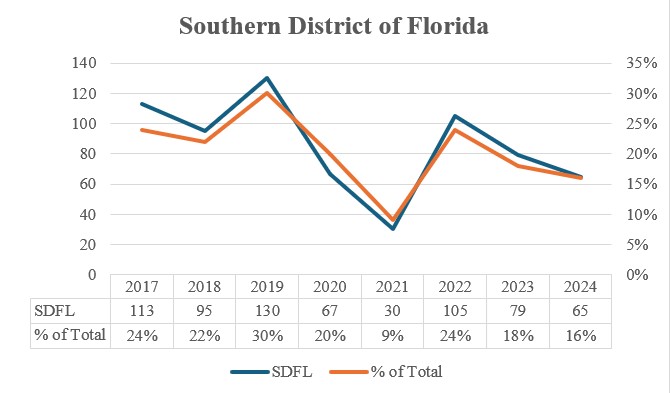
Fraud offenses are one of the categories that have experienced a decrease. In 2017, 7,165 defendants were charged in fraud cases in federal court. By 2025, that number had decreased approximately 22% to 5,553 defendants.
In the data published quarterly on the U.S. Courts’ website, the fraud category is broken down into 19 subcategories. One of those is “Health Care.” In 2017, the Health Care subcategory ranked sixth among subcategories, with 447 defendants. By 2025, the Health Care subcategory was ranked eighth, with 205 defendants, a 54% drop. As shown in the following chart, the decline in Health Care defendants mirrored the decrease in the total number of fraud defendants:
[1] Fla. H.R., Bill History, https://www.flhouse.gov/Sections/Bills/billsdetail.aspx?BillId=83324 (last visited Apr. 27, 2026).
[2] Fla. H.B. 697 (2026).
[3] See What are pharmacy benefit managers (PBMs) and why we need reform?, AMA (Feb. 4, 2026), https://www.ama-assn.org/health-care-advocacy/access-care/what-are-pharmacy-benefit-managers-pbms-and-why-we-need-reform.
[4] See Pharmacy Benefit Managers: The Powerful Middlemen Inflating Drug Costs and Squeezing Main Street Pharmacies, F.T.C. (2024) https://www.ftc.gov/system/files/ftc_gov/pdf/pharmacy-benefit-managers-staff-report.pdf.
[5] F.T.C., supra note 4 (stating that “the leading PBMs are each part of massive healthcare conglomerates that are often comprised of a health insurer, pharmacies, and the PBM negotiator between health insurers and pharmacies—all rolled into one.”).
[6] Ch. 2026-4, Laws of Florida, https://laws.flrules.org/2026/4; Ch. 2023-29, Laws of Florida, https://laws.flrules.org/2023/29.
[7] Ch. 2026-4, Laws of Florida, https://laws.flrules.org/2026/4.
[8] Id.
[9] See id.
[10] Id.
[11] Id.
[12] Id.
[13] See id.
[14] F.T.C., supra note 4.
[15] See F.T.C., supra note 4 (“[H]orizonal consolidation along with vertical integration may have created and compounded financial conflicts of interest and incentives for self-dealing as well as other PBM business practices that lessen competition, disadvantage rivals, and inflate drug costs—all to the detriment of patients.”).
[16] Ch. 2026-4, Laws of Florida, https://laws.flrules.org/2026/4.
[17] Id.
[18] Id.
[19] Id.
[20] U.S. Dep’t of Health & Hum. Servs., Office for Civil Rights, Office for Civil Rights Announces Civil Enforcement Program for Confidentiality of Substance Use Disorder Patient Records (Feb. 13, 2026).
[21] U.S. Dep’t of Health & Hum. Servs., Understanding Confidentiality of Substance Use Disorder (SUD) Patient Records or “Part 2” (last reviewed Feb. 13, 2026).
[22] Confidentiality of Substance Use Disorder (SUD) Patient Records, 89 Fed. Reg. 12,472 (Feb. 16, 2024).
[23] U.S. Dep’t of Health & Hum. Servs., Office for Civil Rights, Breach Reporting Portal.
[24] 42 C.F.R. § 2.31.
[25] 42 C.F.R. § 2.54.
[26] 42 C.F.R. § 2.52.
[27] Fla. Stat. § 397.501.
[28] U.S. Dep’t of Health & Hum. Servs., Model Notices of Privacy Practices; U.S. Dep’t of Health & Hum. Servs., Model Part 2 Patient Notice.
[29] 42 C.F.R. § 2.13.
[xxx] “National Health Care Fraud Takedown Results in 324 Defendants Charged in Connection with Over $14.6 Billion in Alleged Fraud,” Justice Dept. Press Release (June 30, 2025), https://www.justice.gov/opa/pr/national-health-care-fraud-takedown-results-324-defendants-charged-connection-over-146.
[xxxi] “False Claims Act Settlements and Judgments Exceed $6.8B in Fiscal Year 2025,” Justice Dept. Press Release (Jan. 16, 2025), https://www.justice.gov/opa/pr/false-claims-act-settlements-and-judgments-exceed-68b-fiscal-year-2025.
[xxxii]This data comes from Table D-2 of the “Caseload Statistic Data Tables” found on the U.S. Courts’ website (https://www.uscourts.gov/statistics-reports/caseload-statistics-data-tables). The data in this article is reported based on the federal fiscal year, which runs from October 1 of a year to September 30 of the following year. For example, when this article references data for 2017, that means that the data is for the fiscal year that started on October 1, 2016 and that ended on September 30, 2017.
[xxxiii] The number of defendants charged with sex offenses (typically involving the sexual exploitation of children) ranged from 3,075 in 2022 to 3,513 in 2025. The number of defendants charged with firearms offenses experienced greater fluctuation, with 9,391 in 2024 and 12,479 in 2019. The number of firearm defendants was 9,525 in 2017 and 9,555 in 2025.
The number of defendants charged is just one measure that should be considered in reviewing prosecution trends. The reason is that a defendant charged with a $100 million loss is considered to be the same as a defendant charged in a case involving a $100 loss when only the number of cases is considered. But, those cases are not the same. In general, larger loss cases often involve more sophisticated schemes, cause greater financial harm to victims, and require more prosecutorial and investigative resources, among other things.
For those reasons and others, another measure that may assist in providing a more complete understanding of the trend in criminal prosecutions is the amount of loss. The acceptance of this measure as an indicator of the potential significance of a case is well recognized. For example, in its Justice Manual, the DOJ identifies the amount of economic harm caused by an offense as a factor to be considered in determining whether a federal prosecution will serve a “substantial federal interest.”[i]
Data on fraud losses also has the benefit of being readily available. On an annual basis, the U.S. Sentencing Commission reports data about the amount of median losses in health care fraud cases.[ii] A “median” loss is the middle value in a dataset of losses, with more than half the cases above that amount and half below that amount. Compared with average losses, median losses are less susceptible to being skewed by outliers.
From 2018 to 2025, the amount of median loss in fraud cases more than doubled, rising from $62,000 in 2018 to $149,856 in 2025. This trend did not always follow a straight line. In 2019 and 2020, median fraud loss decreased. It then increased every year after that.[iii]
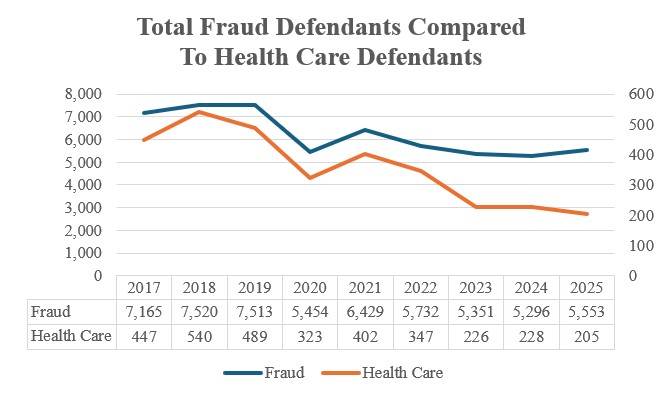
A similar trend was seen in the median fraud loss in health care fraud prosecutions. After fluctuating from 2018 to 2021, the amount of median fraud loss increased in every year after that, rising 29% in 2022, 9% in 2023, and 79% in 2024. In 2024 (which is the most recent year for which data is available), the median fraud loss in health care fraud cases was more than $2.5 million, which was more than double what it was back in 2017. The following chart reflects those trends:
[i] The Principles of Federal Prosecution provide: “[t]he impact of an offense on the community in which it is committed can be measured in several ways: in terms of economic harm done to community interests[.]” Just. Manual § 9-27.230.
[ii] Sentencing Commission data is based on sentenced cases, as opposed to the filing of charges. As a result, Sentencing Commission data cannot always be tied directly to data reported by the U.S. Courts on its website.
[iii]See generally Roger B. Handberg, “Fewer Smaller Cases: A Review of Trends in Federal White-Collar Prosecutions from 2017 to 2024,” Criminal Justice 17, 22 (Fall 2025).
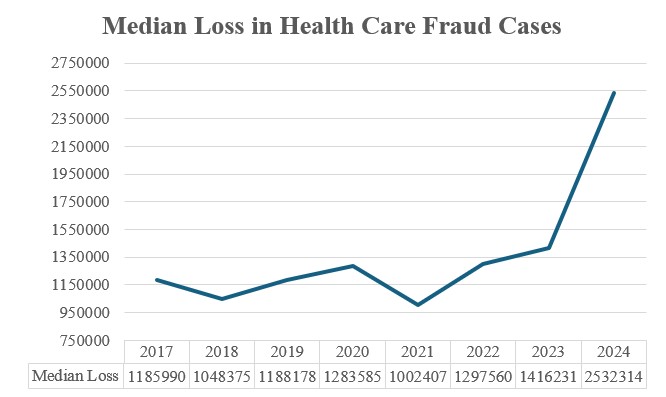
One trend that has remained consistent is that the Strike Force in the Southern District of Florida continues to be at the top in terms of the number of health care fraud prosecutions. From 2017 to 2024, the Southern District of Florida was the only district in the top five in the country every year for health care fraud cases, as reported by the U.S. Sentencing Commission. In every one of those years, except for one, the Southern District of Florida had the most health care fraud defendants sentenced, ranging from 9% (in 2021) to 30% (in 2019) of the total number of those defendants.
This success is not unexpected. The Southern District of Florida was the location of the DOJ’s first Health Care Fraud Unit’s Strike Force back in 2007.[i] Since then, the Strike Force has been expanded to Tampa and Orlando in the Middle District of Florida, and it is known as the Florida Strike Force. The following chart shows the number of health care fraud cases sentenced in the Southern District of Florida from 2017 to 2024, and its percentage of total cases in those years, as reported by the U.S. Sentencing Commission:
[i]“Florida Strike Force,” Justice Dept. website, https://www.justice.gov/criminal/criminal-fraud/miami-strike-force-operations.
Overview of Trends in Civil Health Care Fraud Enforcement
The amount of loss has increased in criminal health care prosecutions. A similar trend has been seen in civil enforcement actions brought under the False Claims Act.
In general, the False Claims Act provides two avenues for recovery: (1) the government may pursue an investigation and either settle the case or file suit, or (2) a private citizen, known as a relator, may file a “qui tam” action on behalf of the U.S. If a relator files a qui tam suit, “[a] copy of the complaint and written disclosure of substantially all material evidence and information the person possesses shall be served on the Government[.]”[i] The complaint remains under seal for at least 60 days, and it is not served on the defendant. During that time period (which may be extended upon a showing of good cause), the DOJ evaluates the case and decides whether to intervene and proceed with the action or to decline intervention and allow the relator to conduct the action.[ii]
The DOJ has published statistics on recoveries from False Claims Act investigations and cases.[iii] The statistics cover the period from 1987 to 2025 and are broken down into four categories: the DOJ’s Civil Division, Health and Human Services (HHS), the Department of Defense (DOD), and Other.
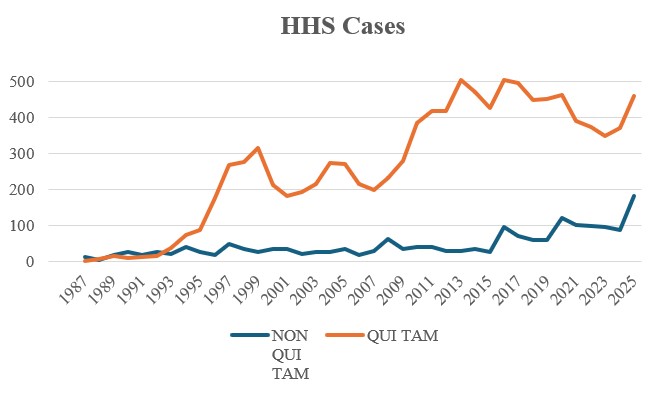
As these statistics show, it did not take long for the number of qui tam cases to increase after the 1986 amendments to the False Claims Act. From 1987 to 1994, the number of non-qui tam actions was greater than the number of qui tam actions. Since 1994, the trend has been the opposite, with the number of qui tam actions consistently exceeding the number of non-qui tam actions each year.
This trend is particularly prevalent in health care fraud-related matters. Using the HHS statistics as a proxy for health care fraud matters, the number of health care fraud qui tams has greatly exceeded the number of non-qui tam health care fraud matters every year since 1994:
[i] 31 U.S.C. § 3730(b)(2).
[ii] It also is possible that the Justice Department may elect to intervene and “dismiss the action notwithstanding the objections of the person initiating the action if the person has been notified by the Government of the filing of the motion and the court has provided the person with an opportunity for a hearing on the motion.” 31 U.S.C. § 3730(c)(2)(A). See generally United States ex rel. Polansky v. Executive Health Resources, Inc., 599 U.S. 419, 430 (2023) (“So the Government can file a (2)(A) motion to dismiss whenever (whether during the seal period or later) it has intervened.”).
[iii]“FY2025 FCA Stats,” Justice Dept. website, https://www.justice.gov/opa/media/1424121/dl.
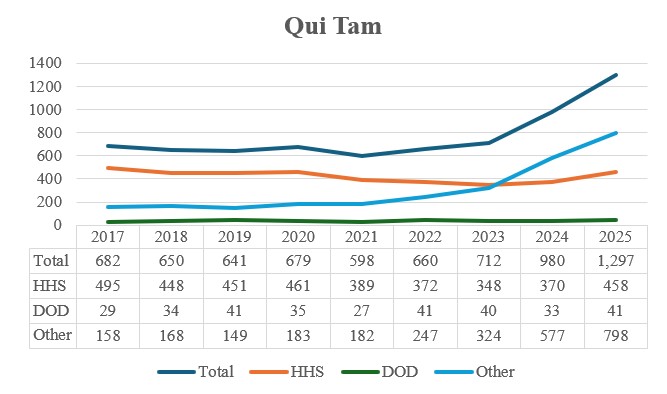
For many years, health care fraud qui tams were the largest component of the overall number of qui tams. This changed in 2023 as the number of qui tams in the Other category began to increase (likely due to the filing of COVID fraud-related qui tams):
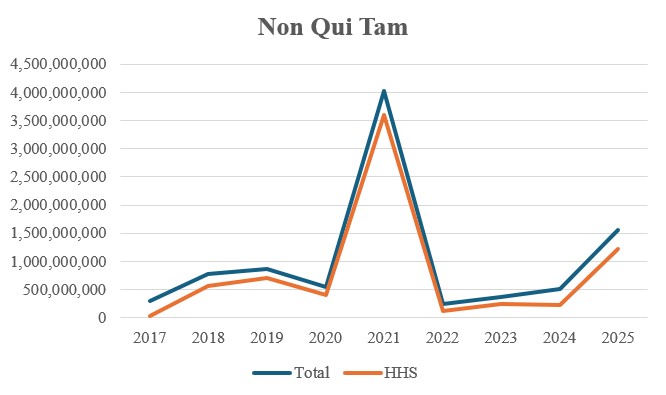
Regardless of how the data is viewed, health care fraud-related False Claims Act matters generate a substantial portion of recoveries almost every year. This is true for non-qui tam matters:
It is equally true for qui tam matters:
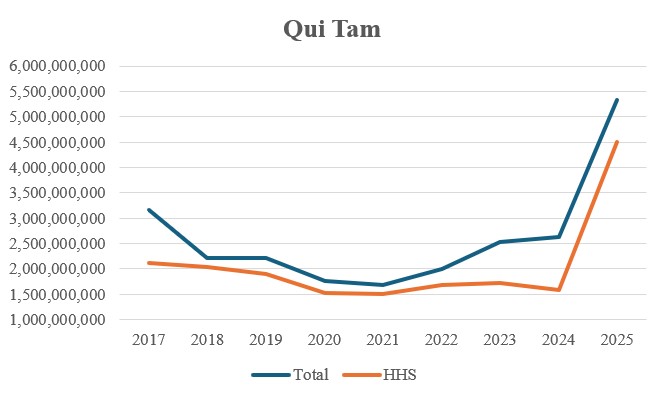
In most years, the government’s recoveries from False Claims Act investigations and cases rise and fall in tandem with the recoveries in health care fraud matters. But, there are two trends within this trend that are worthy of note.
First, in almost every year, recoveries in qui tam cases exceed those for non-qui tam cases. From 2017 to 2025, the total amount of recoveries in non-qui tam health care fraud cases exceeded $7 billion. Those recoveries were significant, but the recoveries in qui tam cases were more than double that amount, at $18.5 billion. Since 2006, there has not been a single year in which recoveries in health care fraud qui tam cases were less than $1 billion. By contrast, there were only three of those 20 years when non-qui tam recoveries exceeded $1 billion. With one exception (in 2021), qui tam recoveries have constituted the largest portion of False Claims Act recoveries in health care fraud cases every year from 1997 onward.
Second, a substantial portion of health care fraud qui tam recoveries are occurring in cases that were handled by relators after being declined by the DOJ. For the first 20 years or so after the 1986 amendments to the False Claims Act, it was a common assumption that a qui tam action would not succeed if the DOJ declined to intervene. The statistics supported that view. From 1987 to 2006, the largest amount of recoveries in any one year for declined health care fraud cases was in 2002, totaling approximately $23 million. Compared against the $937 million recovered that year from qui tam actions in which the DOJ intervened, the amount of recoveries in declined qui tam cases in 2002 was a small fraction of the overall qui tam recoveries for that year.
The first year with more than $100 million in recoveries in declined health care fraud qui tam cases was 2007. That year, however, was not the start of a longer trend. Recoveries dropped the following year to approximately $8 million and remained below $100 million until 2013.
In that year, recoveries in declined health care fraud qui tam cases topped $100 million. From that point forward, with the exception of two years (2014 and 2016, both with $75 million in recoveries), the recoveries in those cases have exceeded $100 million. From 2017 to 2025, total recoveries in declined health care fraud qui tam cases exceeded $5 billion, with two years recording recoveries of more than $1 billion (approximately $1,020,752 in 2022 and $2,274,416 in 2025). The recoveries in those two years, 2022 and 2025, are the only times when recoveries by relators have exceeded those by the DOJ in qui tam cases:
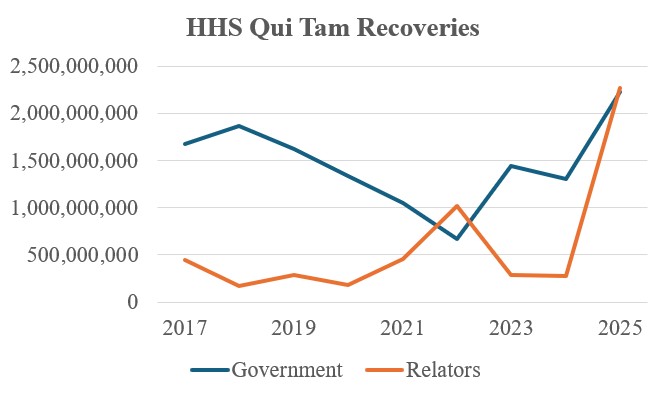
These statistics demonstrate that the DOJ’s decision as to whether to intervene is not a predictor of the potential for recovery in a qui tam case. While it may have been unlikely in the past for a relator and their counsel to seek to pursue a health care fraud qui tam that had been declined by the DOJ, that is no longer the case. Relators and their counsel have demonstrated the ability to use their resources effectively to identify potential violations and to pursue significant recoveries. Coupled with recoveries in DOJ investigations and cases, this trend contributed to the largest amount of total recoveries in health care fraud civil matters ever in 2025.
Conclusion
The trends in criminal and civil health care fraud enforcement should be considered together. In criminal cases, prosecutions are less likely, but the focus of the DOJ is on cases with larger financial losses. Florida continues to be a focus of health care fraud investigations and prosecutions, especially from the Florida Strike Force in Miami, Tampa, and Orlando.
At the same time, financial recoveries in civil cases remain significant, but most of those recoveries derive from qui tam cases brought by relators. And, of those, relators are handling more of those cases and are doing so successfully. Health care providers facing a False Claims Act investigation can no longer focus solely on convincing the DOJ to decline intervention.[1] In addition to seeking that result, health care providers must be prepared to litigate the case with relators who have demonstrated the ability to obtain significant results in the cases that they have handled.
These trends in civil recoveries highlight the significance of the impending decision of the Eleventh Circuit Court of Appeals in United States ex rel. Zafirov v. Florida Medical Associates, 751 F. Supp. 3d 1293 (M.D. Fla. 2024). In that case, the district court held that the False Claims Act’s qui tam provision is unconstitutional and violates the Appointments Clause of Article II.
The case is on appeal, and oral argument was held in December 2025. If the district court’s ruling is upheld, the landscape of federal civil enforcement of health care fraud would change dramatically.[2] The government would no longer be able to rely on relators to identify potential health care fraud schemes through the filing of qui tam actions. Nor would it be able to count on the significant recoveries that relators have been obtaining in qui tam cases that the DOJ has declined. The DOJ would have to consider deploying additional resources to maintain the same level of financial recoveries in health care fraud cases.
Only time will tell if the DOJ will be placed in such a situation. If relators are no longer authorized to bring qui tam actions, federal affirmative civil enforcement would become the government’s sole responsibility. The situation in civil cases would then be similar to what it is in criminal cases, where the government is the one responsible for initiating and litigating cases in federal court. Such a change would be significant, as it would depart from the way in which False Claims Act cases are currently handled.
Submitted and authored by Roger B. Handberg, Esq. and Julie Posteraro, Esq., GrayRobinson, P.A.
[1] An important part of any such representation also is considering the possibility of requesting the United States to intervene for the purposes of dismissing the case. See Polansky, 599 U.S. at 430.
[2] Regardless of the result reached by the Eleventh Circuit, there is the potential for Supreme Court review of the issues raised in Zafirov in that or some other case. If the qui tam provisions are found to be unconstitutional, there also is the possibility of legislative proposals to amend the False Claims Act. Discussion of these possibilities, and the impacts they may have on federal enforcement efforts, is beyond the scope of this article.
[1] “National Health Care Fraud Takedown Results in 324 Defendants Charged in Connection with Over $14.6 Billion in Alleged Fraud,” Justice Dept. Press Release (June 30, 2025), https://www.justice.gov/opa/pr/national-health-care-fraud-takedown-results-324-defendants-charged-connection-over-146.
[2] “False Claims Act Settlements and Judgments Exceed $6.8B in Fiscal Year 2025,” Justice Dept. Press Release (Jan. 16, 2025), https://www.justice.gov/opa/pr/false-claims-act-settlements-and-judgments-exceed-68b-fiscal-year-2025.
[3]This data comes from Table D-2 of the “Caseload Statistic Data Tables” found on the U.S. Courts’ website (https://www.uscourts.gov/statistics-reports/caseload-statistics-data-tables). The data in this article is reported based on the federal fiscal year, which runs from October 1 of a year to September 30 of the following year. For example, when this article references data for 2017, that means that the data is for the fiscal year that started on October 1, 2016 and that ended on September 30, 2017.
[4] The number of defendants charged with sex offenses (typically involving the sexual exploitation of children) ranged from 3,075 in 2022 to 3,513 in 2025. The number of defendants charged with firearms offenses experienced greater fluctuation, with 9,391 in 2024 and 12,479 in 2019. The number of firearm defendants was 9,525 in 2017 and 9,555 in 2025.
[5] The Principles of Federal Prosecution provide: “[t]he impact of an offense on the community in which it is committed can be measured in several ways: in terms of economic harm done to community interests[.]” Just. Manual § 9-27.230.
[6] Sentencing Commission data is based on sentenced cases, as opposed to the filing of charges. As a result, Sentencing Commission data cannot always be tied directly to data reported by the U.S. Courts on its website.
[7]See generally Roger B. Handberg, “Fewer Smaller Cases: A Review of Trends in Federal White-Collar Prosecutions from 2017 to 2024,” Criminal Justice 17, 22 (Fall 2025).
[8]“Florida Strike Force,” Justice Dept. website, https://www.justice.gov/criminal/criminal-fraud/miami-strike-force-operations.
[9] 31 U.S.C. § 3730(b)(2).
[10] It also is possible that the Justice Department may elect to intervene and “dismiss the action notwithstanding the objections of the person initiating the action if the person has been notified by the Government of the filing of the motion and the court has provided the person with an opportunity for a hearing on the motion.” 31 U.S.C. § 3730(c)(2)(A). See generally United States ex rel. Polansky v. Executive Health Resources, Inc., 599 U.S. 419, 430 (2023) (“So the Government can file a (2)(A) motion to dismiss whenever (whether during the seal period or later) it has intervened.”).
[11]“FY2025 FCA Stats,” Justice Dept. website, https://www.justice.gov/opa/media/1424121/dl.
[12] An important part of any such representation also is considering the possibility of requesting the United States to intervene for the purposes of dismissing the case. See Polansky, 599 U.S. at 430.
[13] Regardless of the result reached by the Eleventh Circuit, there is the potential for Supreme Court review of the issues raised in Zafirov in that or some other case. If the qui tam provisions are found to be unconstitutional, there also is the possibility of legislative proposals to amend the False Claims Act. Discussion of these possibilities, and the impacts they may have on federal enforcement efforts, is beyond the scope of this article.